Introduction
How Does CONFLUX Work?
The CONFLUX (Calculation Of Neutrino FLUX) software framework is built with the goal to simplify and standardize neutrino flux calculations. CONFLUX is packaged with three prediction modes:
Summation mode
\(\beta\) Conversion mode
Direct neutrino data mode
CONFLUX uses parsered nuclear data, theoretical beta/neutrino spectrum calclation, and existing beta/neutrino measurement from fissile isotopes to calculate reactor or beta decay neutrino productions. The full documentation has been published in BLAH.
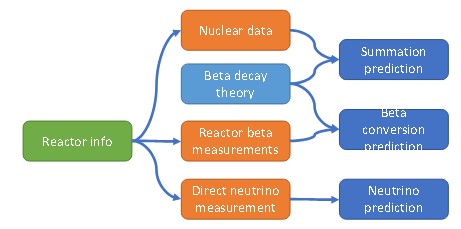
CONFLUX was built aiming to help researchers with limited programming and nuclear data knowledge to calculate neutrino flux with ease. Features include:
Calculating neutrino spectrum and flux from customized model of nuclear reactor
Beta and neutrino spectrum with non-zero neutrino mass
Allow user input of covariance matrix among fission product yields
Neutrino flux evolution over time from independent fission yields
Calculating neutrino flux with customized beta decay function, updated nuclear data, or individually modified isotopic data
Modes
Summation
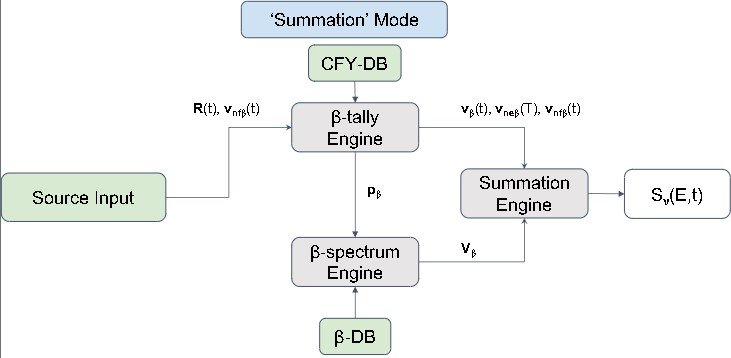
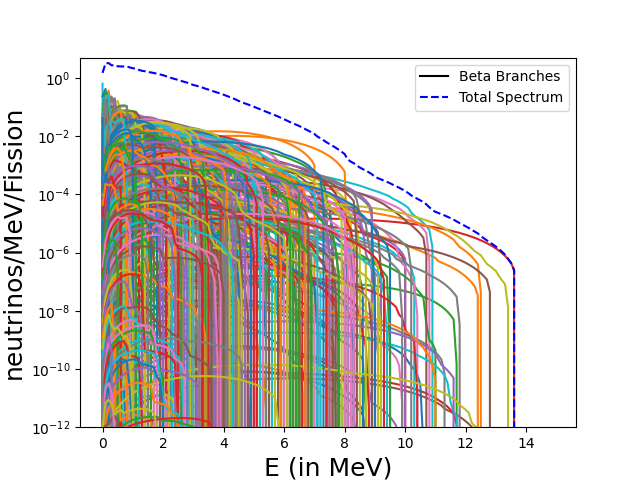
Summation mode is an ab-initio calculation that takes in Fission product information, either from ENDF, JEFF, or a user-defined DB, and combines it with the spectral shape of each individual
\(\beta\)-branch. Thus, we sum the product of the individual branch spectra and their contributions to form the total neutrino spectrum for a given isotope. A block diagram of how the mode works,
as well as a graphical representation of the calculation is provided below.
Conversion
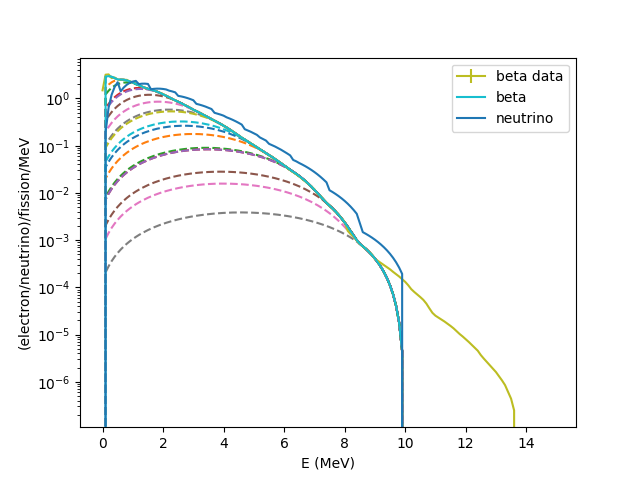
Conversion mode converts an inputted beta spectrum of some fissile isotope and converts it into a neutrino spectrum by fitting it with virtual branches that approximate neutrino decay branches. Packaged beta databases lack corrections for non-equilibrium fission products,
however one can use the Summation calculation with prior knowledge of the modeled reactor to work around this. See also synth_data.py. A block diagram of how the mode works, as well as a graphical representation of the calculation is provided below.

Direct Experimental Measurement
This is a planned prediction mode that will be implemented at a later date. More on how the calculation will be carried out can be seen here.
Databases
ENDF/JEFF
ENDF and JEFF are Nuclear Databases containing Fission Yields of Individual Fission Isotopes. Either can be selected in the calculation by specificying which Database in the Default_DB variable where required.
Some key notes on the parsed data include
- HEAD AWR
- FissionZA : This is an identifier for this specific Isotope, combining both its’ atomic number and mass.
- LE
- MT : Determines whether that specific set of data is an Indpendant Yield IFP or a Cumulative Yield CFP
- Ei : This is the incident neutron energy that causes the fission. Value can either be 0 (thermal), 0.5 (fast), or 14 (relativistic)
- Ii
- NFPI
<nfy-092_U_235>
	<HEAD AWR="233.025" FissionZA="92235" LE="3" MT="IFP">
		<LIST Ei="0.0253" Ii="2" NFPi="1247">
			<CONT DY="1.3122e-19" FPS="0.0" Y="2.05032e-19" ZA="23066"/>
			<CONT DY="1.54228e-14" FPS="0.0" Y="2.40981e-14" ZA="24066"/>
			<CONT DY="0.0" FPS="0.0" Y="0.0" ZA="24067"/>
			<CONT DY="0.0" FPS="0.0" Y="0.0" ZA="24068"/>
			<CONT DY="1.34924e-18" FPS="0.0" Y="2.10819e-18" ZA="24069"/>
			<CONT DY="0.0" FPS="0.0" Y="0.0" ZA="24070"/>
			<CONT DY="4.60767e-12" FPS="0.0" Y="7.19949e-12" ZA="25066"/>
			<CONT DY="3.44296e-12" FPS="0.0" Y="5.37962e-12" ZA="25067"/>
			<CONT DY="4.2621e-13" FPS="0.0" Y="6.65953e-13" ZA="25068"/>
			<CONT DY="5.1387e-14" FPS="0.0" Y="8.02922e-14" ZA="25069"/>
			<CONT DY="0.0" FPS="0.0" Y="0.0" ZA="25070"/>
			<CONT DY="0.0" FPS="0.0" Y="0.0" ZA="25071"/>
			<CONT DY="3.89305e-18" FPS="0.0" Y="6.08289e-18" ZA="25072"/>
ENSDF
<betaDB>
	<isotope name="H3" isotope="10030" Q="0.0185906" HL="388523520.0" Ex="0.0">
		<branch fraction="1.000" sigma_frac="0.000" end_point_E="0.019" sigma_E0="0.000" dJpi="0"/>
	</isotope>
	<isotope name="He6" isotope="20060" Q="3.5078" HL="0.8067000000000001" Ex="0.0">
		<branch fraction="1.000" sigma_frac="0.000" end_point_E="3.508" sigma_E0="0.001" dJpi="1"/>
	</isotope>
	<isotope name="He8" isotope="20080" Q="10.651" HL="0.1191" Ex="0.0">
		<branch fraction="0.840" sigma_frac="0.010" end_point_E="9.671" sigma_E0="0.008" dJpi="1"/>
		<branch fraction="0.160" sigma_frac="0.000" end_point_E="7.571" sigma_E0="0.007" dJpi="1"/>
		<branch fraction="0.160" sigma_frac="0.000" end_point_E="5.501" sigma_E0="0.007" dJpi="1"/>
		<branch fraction="0.009" sigma_frac="0.001" end_point_E="0.981" sigma_E0="0.007" dJpi="1"/>
	</isotope>
	<isotope name="Li8" isotope="30080" Q="16.00516" HL="0.8399" Ex="0.0">
		<branch fraction="1.000" sigma_frac="0.000" end_point_E="12.975" sigma_E0="0.010" dJpi="0"/>
	</isotope>
FyCOM
Prepackaged example covariance and correlation matrices are included for the fission products from U-235, U-238, Pu-239, and Pu-241, calculated by the work referred in https://nucleardata.berkeley.edu/FYCoM/, a MC calculation based on ENDF.B/VIII and JEFF-3.3. The user can download the referred covariance matrices by running
python3 $CONFLUX_DB/CovMatDownloader.py